
Table of Contents
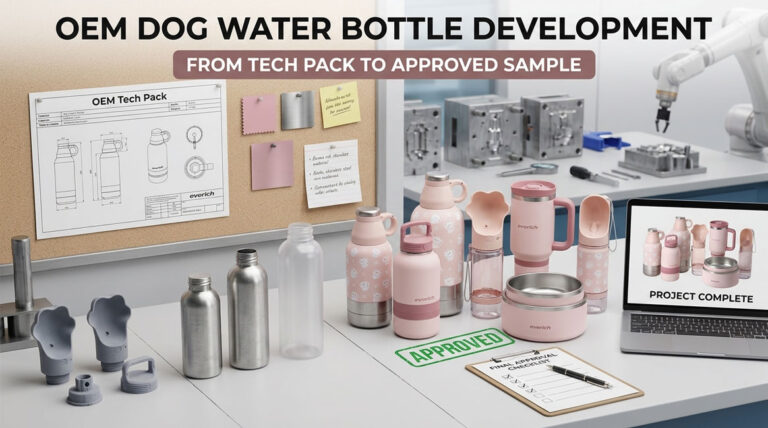
Quick answer: An OEM dog water bottle is ready for bulk production only when the buyer and supplier agree on what will be made and which sample represents it. Start with a revision-controlled tech pack. Confirm the design and cost assumptions, review a working sample against functional requirements, close each change, and sign off a pre-production sample that matches the intended materials, branding, and packaging. A rendering or attractive photo is not enough to approve a bottle’s seal, dispensing mechanism, or retail pack.
Dokipetty’s public customization process describes a high-level path from idea or drawing to quotation, design, sample modification, final product, and bulk delivery. The checkpoints below are a recommended buyer-side framework, not a claim that every Dokipetty project follows identical internal gates. Agree on the actual sequence and documents for your selected model before placing an order.
First, define what you are developing
“Custom dog water bottle” can mean three different scopes. Name yours in the inquiry so a sample quote is meaningful.
| Development route | Typical starting point | What the buyer should clarify |
|---|---|---|
| Existing model with branding | A selected bottle from the dog water bottle range | Exact model, color, logo position, artwork, packaging, and whether any component changes. |
| Modified existing design | A reference model plus changes to a lid, bowl, strap, material, or other part | Which existing parts remain, whether revised parts need tooling, and which tests must be repeated. |
| Buyer-defined new design | Your own drawings and functional specification | Design responsibility, prototype method, tooling ownership and cost, validation plan, and revision rules. |
These are planning categories, not a promise that every option is available for every SKU. If the manufacturer supplies the base design rather than building to your drawings, the project may be closer to ODM or private label; see Dokipetty’s OEM/ODM overview for that distinction. Either way, use one agreed specification to prevent “same bottle, different expectations.”
Build a tech pack that can be quoted and sampled
A useful tech pack is a decision document, not just a mood board. Mark each item as required, preferred, or open for supplier proposal, and assign a drawing or document revision. If a requirement is still undecided, do not hide it in a verbal conversation.
| Tech-pack field | Information to provide or request |
|---|---|
| Product identity | Working SKU, reference product or drawings, revision number, intended user and use scenario, target sales markets. |
| Bottle and components | Target capacity and dimensions; preferred body, lid, bowl/trough, gasket, valve, button, strap, and any food-storage configuration. Identify water-contact parts separately. |
| Functional criteria | How water dispenses and returns, how the closure locks, cleaning and reassembly expectations, and agreed leak-resistance and durability test conditions. |
| Appearance | Color reference, finish, logo size and placement, artwork files, and what visual variation is acceptable. |
| Packaging | Retail box, instructions, barcode location, protective packing, carton marks, and any market-specific labeling the buyer requires. |
| Acceptance evidence | Dimensions and tolerances to check, functional pass/fail rules, sample IDs, required test records, and which documents must accompany final approval. |
| Commercial assumptions | Forecast quantity, requested order quantity, delivery destination, sample quantity, target handover date, and any tooling or exclusivity questions. |
For a bottle with a drinking bowl or push-button dispenser, an exploded view or annotated component list is especially useful: it shows whether “bottle” includes the gasket, valve, button, bowl, and spare or removable parts. If the target market requires specific material or labeling documentation, ask for evidence applicable to the final configuration; do not treat a statement about a material family as proof for every SKU. Dokipetty describes general materials and logo-file options on its customization page, but model-level feasibility still needs confirmation.
Use approval gates instead of approving one photo
The following gates turn “please make a sample” into a series of explicit decisions. Ask the project team which gates can be combined for a simple branding change and which need a separate physical sample for a modified or new design.
| Gate | Buyer decision | Record to keep |
|---|---|---|
| 0. Feasibility and quotation | Can the proposed configuration be made, and what assumptions affect price, tooling, sampling, timing, and MOQ? | Written scope, open questions, itemized quote, and ownership of decisions. |
| 1. Drawing and artwork release | Do the dimensions, components, materials, graphics, and packaging brief describe the intended product? | Approved tech-pack revision, drawings, artwork proof, and a list of unresolved items. |
| 2. Working sample review | Does the physical bottle fit together, dispense and close as intended, and meet the agreed preliminary checks? | Identified sample, measured observations, defect photos, test conditions, and requested changes. |
| 3. Revision closure | Were problems corrected without creating new ones? | Change log linking each issue to a new drawing or sample revision and any affected retests. |
| 4. Pre-production sample sign-off | Does the representative finished configuration meet the agreed appearance, function, materials, and packaging requirements? | Signed sample record, retained reference sample, approved files, and production/QC acceptance criteria. |
A visual mock-up may answer a color or placement question without proving that a valve seals. Likewise, a working prototype may demonstrate the mechanism while using materials or finishes that will change for production. Label each sample by its purpose and limitations. For a new or revised water path, agree on leak and dispensing checks before you decide that a sample is “approved.” Dokipetty’s quality-control page mentions leak testing among its general inspections, but it does not publish a test protocol for your proposed configuration.
When a sample fails, describe the defect rather than asking the supplier to “improve quality.” For example: identify the sample ID, fill condition, closure position, leak location, number of trials, and photos. Agree on the correction, then retest the changed part and any function it could affect. An updated lid or gasket may require a new functional approval even if the bottle body’s color is unchanged.
Treat finishes and packaging as part of sample approval
The surface treatment, logo method, and retail presentation can affect both appearance and the approval schedule. Ask which options are feasible for the selected substrate and model, what artwork format is required, and whether the finish needs an agreed adhesion, wear, or cleaning check. Confirm color against a physical reference where consistency matters; screen colors alone are not a reliable approval standard.
Approve the assembled, branded sample and its packaging together when those are part of the order. Check that the instruction leaflet, barcode, carton marks, inserts, and any accessories correspond to the same SKU and revision. If only an unbranded engineering sample is available, record branding and packaging as not yet approved rather than silently treating the product as finished.
Ask for a conditional timeline and MOQ, not a generic number
Sampling and order thresholds depend on the chosen design, material, finish, tooling, test scope, and number of revisions. A logo-only project and a newly tooled dispensing mechanism should not be given the same planning assumption. Request a written breakdown instead of relying on a site-wide lead-time or MOQ claim.
| Scope to quote | Timing questions | MOQ and cost questions |
|---|---|---|
| Existing model, logo or packaging | Is the base model available? When can artwork and a branded sample be reviewed? | What is the minimum by model, color, logo method, and packaging version? |
| Component or material change | Are new parts or tooling needed? Which tests and approval rounds add time? | Do component suppliers or special materials impose separate minimums? What are revision and tooling charges? |
| New structure or mold | When are drawings frozen, prototype and tooling released, and a pre-production sample available? | Who pays for and owns tooling? Are there setup, color, or component minimums separate from the finished-bottle order? |
Ask whether the quoted calendar starts after receipt of an approved tech pack, after payment, or after tooling release. Separate design review, sampling, revision, testing, production, and transit; ask what happens if the buyer changes artwork or function after sign-off. The final MOQ and schedule should appear in the written quotation or purchase agreement for the exact configuration, not be inferred from a different product page.
Make the approved sample a production reference
Before authorizing bulk production, capture a short sign-off record that both sides can use:
Sample approval record — buyer template
Product/SKU and tech-pack revision: ______
Physical sample ID and approval date: ______
Approved materials, components, color/finish, and artwork files: ______
Approved packaging and accessories: ______
Functional checks, conditions, results, and report references: ______
Open deviations or approved exceptions: ______
Buyer and supplier approvers: ______
Changes requiring renewed approval: ______
Keep the signed record, drawings, artwork, test evidence, and retained physical sample together. If production later changes a specified material, component, finish, mold, or packaging element, compare it with this reference and obtain a documented decision before substitution. The approved sample should be the beginning of repeatable production control, not the end of communication.
Start with a clearer OEM inquiry
Choose a reference from Dokipetty’s dog water bottle range or send your own drawings, then share your tech-pack revision, target markets, estimated quantity, branding and packaging needs, and the functional checks you expect. Ask which specifications are feasible, which stages require a physical sample, and what evidence will be available at sign-off. You can send that brief through the Dokipetty contact page and request a model-specific quotation, sample plan, lead-time assumptions, and MOQ conditions.


